Un nouvel essai trouvé sur Facebook
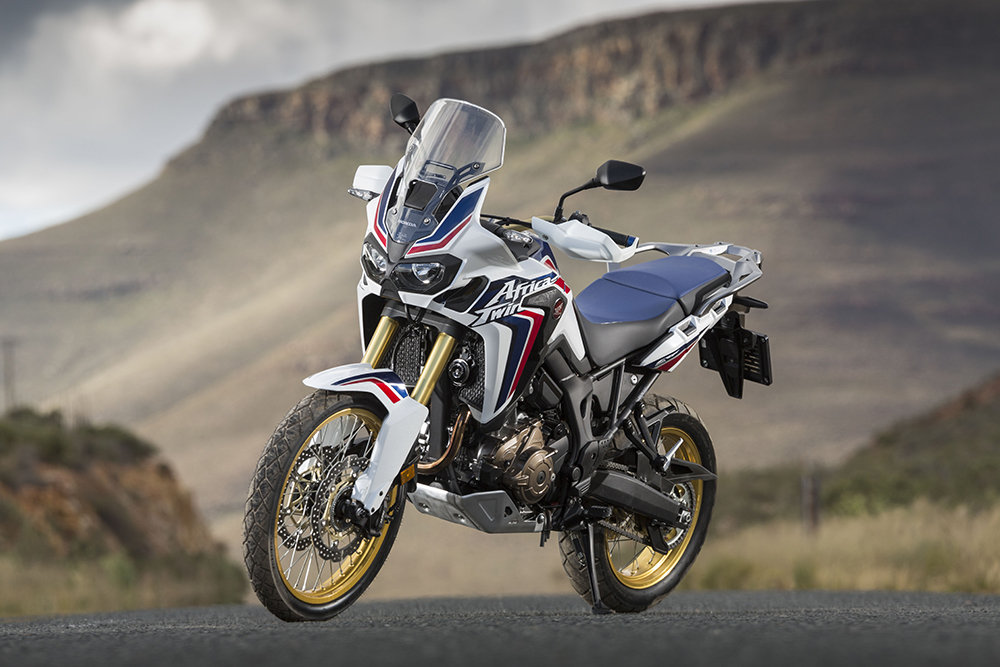
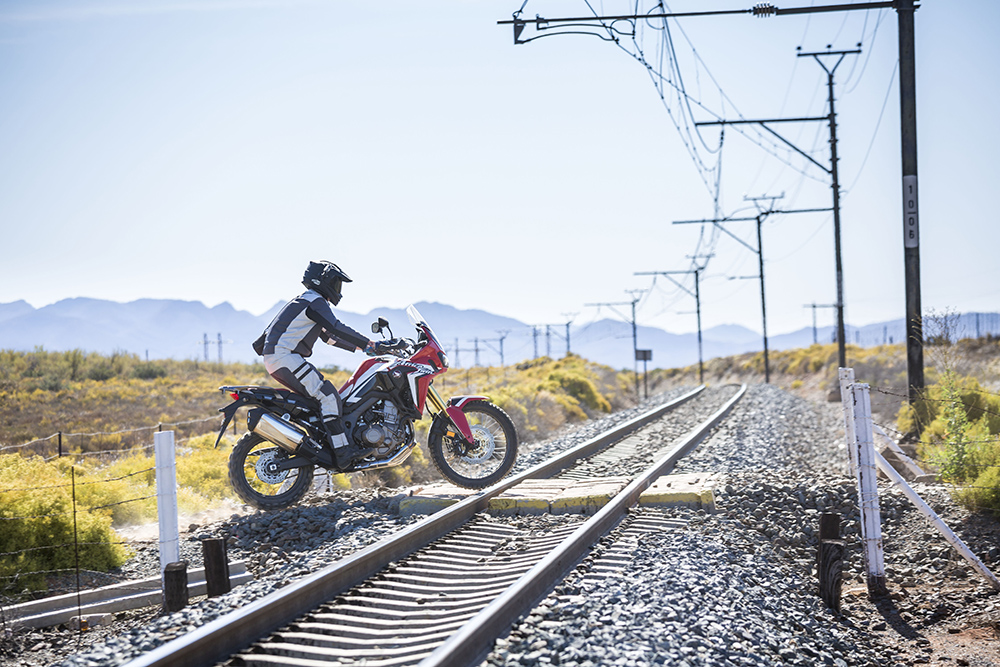
The highly anticipated Honda CRF 1000L Africa Twin was recently launched in South Africa and we were there! I'd like to share some thoughts and impressions on the new bike. This is not an article, but rather a discussion of the bike and my experience on it. There are many aspects to cover and we'll do so with every photo posted. Feel free to ask some questions as we go along and I'll answer as best I can.
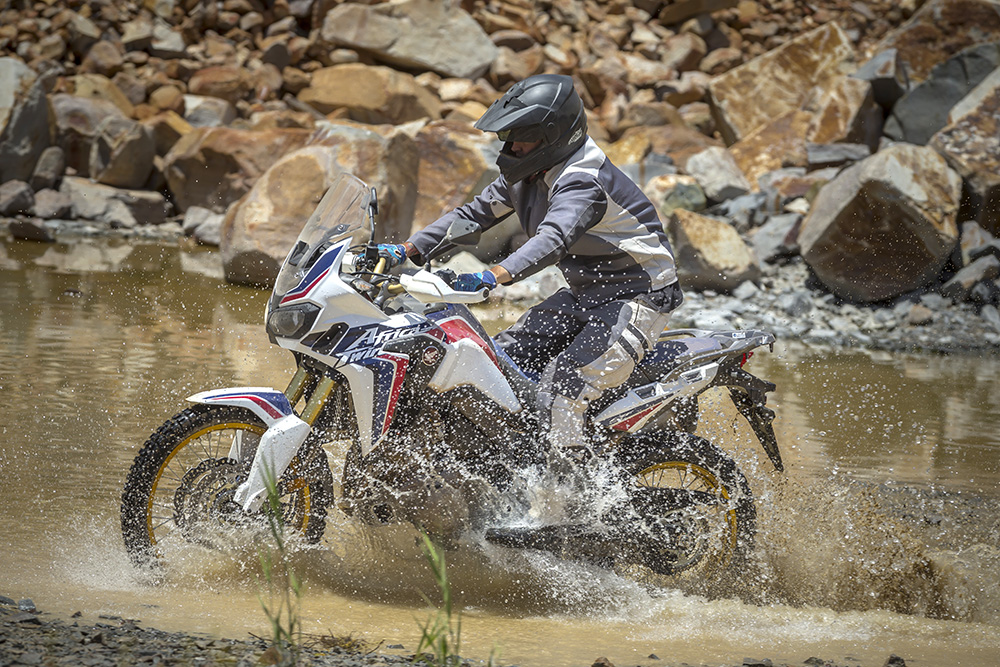
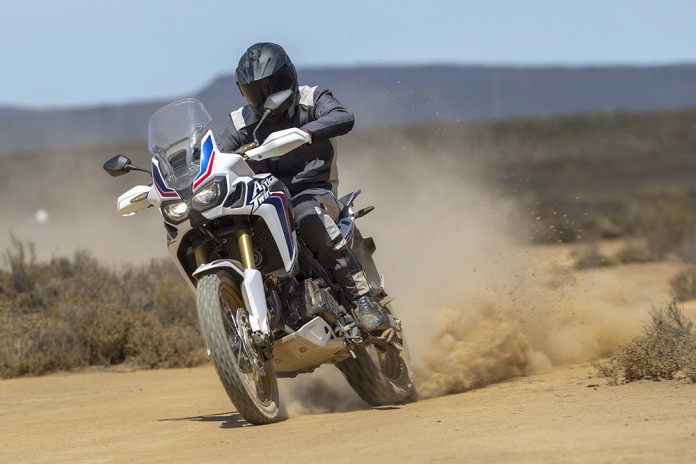
Just as some background - the launch extended over two days. The first day was the "On Road" day, covering close to 300km with about 20% gravel thrown in on road tyres. On this day we got to ride both the DCT and Manual models. The second day was the "Off Road" day with some technical off road riding including Jeep Track, deep (hot) sand, rocks, marbles, water crossings and a quarry ride. The worst bit was a hill climb on (very) loose rocks and of course a descent of the same hill. This day we rode on Continental TKC80’s.
There are 8 rotations of 10 journalists each and we were on the first rotation. I was lucky enough to share this experience with two friends and fellow journalists. The first, Cyril Klopper is an experienced rider both on and off road, the second, Carl Kritzinger rides a Triumph XC 800 and sticks to tar 90% of the time while I prefer the dirt roads and ride gravel 80% of the time. We all have years of riding experience, but with different strengths - the perfect mix to discuss the pros and cons of this bike.


It was astounding to see how many people and specialists worked on this bike. There was a specialist engineer for every aspect and they were present at the launch. We had a wealth of information there for the asking. The same man who worked on the original Africa Twin for the Paris/Dakar (then a young and eager engineer) was a project manager for this new Africa Twin. When I realized this I knew why the project was a success. Rebuilding a modern version of a legend can be a curse. The expectations are so high that it can be near impossible to reach. But this man knew what priorities made the original legendary and they stuck to those priciples.
Manual vs DCT (On-Road).
The first day was divided into two segments before and after lunch. On the first stint I was on the DCT model and after lunch on the manual.
I instantly took to the DCT. I have experienced these boxes before on the VFR1200, Cross Tourer and more recently on the NC750X, but on the Africa Twin the DCT seems to be much more refined. You have several driving modes: Drive and three levels of Sport mode. Then the DCT version also offers a “G” button specifically for off road riding (more about that in the Off Road discussion). Lastly there’s also traction control with three “on” settings and it can be switched off, as well as ABS that can be switched on and off. All these settings mean that the DCT bike can be set up in about 80 combinations!
Having had experience with DCT boxes I played with the settings extensively. The Drive mode was used when I was in touring mood only. And that did not happen often. :D I preferred the sportiest setting as it made the bike feel so alive! I even used this setting on the gravel stints on day one (I stupidly forgot about the G button and only used that on the off road day).
The best part about this DCT box is that it is offered with an optional gear lever where a manual gear lever would be – like a quickshifter (without this you can still change gears manually with your left hand fingers, but it’s not as natural). My bike was fitted with this and I used it at first (in Drive mode) and found it very user friendly. This option means that you can ride this DCT bike as a manual if you prefer. Once in sports mode however I never used it again. This DCT box is so progressive that it changes the gear even before you get the impulse too. You are just ALWAYS in the right gear and at the right revs regardless of where you are and when you gun it the downshifts are instantaneous (and the acceleration addictive!). I was on this bike when we chased down the Crossrunner and always being in the right gear with power on tap helped a lot! All I had to do was pick my lines. He had no chance. :D
At lunch we discussed the bikes and I wondered why anyone, bar price, would prefer the manual over the DCT. Especially with the gearlever the DCT offered you everything that the manual did, but better and of course with all the options the sports and other combination modes offered. My two friends, who were on manual bikes up to this point, was not convinced. But they had no experience riding DCT bikes ever and after lunch would be their first experiences.
So after lunch I mounted the manual bike. Much less options and buttons on this – only the traction control and ABS. Sport mode would be in my left hand and foot – manual! Surprisingly as we took of I was instantly at home. Changing gears yourself means that you are more involved with the riding and it just felt natural. Furthermore the manual bike has a slipper clutch which means that you can change gears without the clutch when you close the throttle. I tried it and it works a charm, but habit had me using the clutch most of the time. Riding up a pass (at speed) I was easily able to catch my tar riding friend Carl who was still trying to get used to the auto bike. :D The manual somehow felt lighter (and it is lighter of course, but not so much that it would feel so pronounced, so I was left wondering if I was imagining things). I could now see that some would prefer the manual box over the DCT. The R20 000 price difference could fund a trip into Africa!
So in the end it’s not a case of one box being better than the other. It’s a matter of taste and regardless of what you choose, Honda has such a model for you. The same goes for the ABS. You can buy the manual model with or without ABS, the option is yours!
More:
Handling (On-Road).
Again, the Africa Twin is built with a strong off road bias and that is what I came to test. The first day however was the “On Road” day and while I was not expecting much this bike is very, very good on tar.
Because of the off road bias the wheels are big – 21” front and 18” back – so you would think that it would not turn in as easily as a sports bike. But this bike is so surprisingly nimble! It almost makes no sense. On route we descended Gydo pass. We had marshals scattered through the group and the rule was that no one may pass a marshal. On the way down we were really giving it horns, leaning through the corners to the point that none of the test bikes had chicken strips at the bottom (my feet touched the ground twice). I was riding behind another Africa Twin who in turn was riding behind a marshal on a Honda Crossrunner. We were all over him like flies. He was riding his road bike hard and we not only kept up, we wanted to pass him several times. If playing in the twisties is part of your biking fun the Africa Twin will not disappoint believe me!
The same applied through Bainskloof Pass, only here I believe the Africa Twin will outrun even a sportsbike purely because of the long travel suspension. The road condition in this pass is poor and bumpy. The Africa Twin’s big wheels and long travel suspension soaked it all up however and we could play here as well as in any other pass.
Power and Performance (On-Road).
Let's start with the elephant in the room - power and weight. Right off the bat - if you're expecting 1200 power you are looking in the wrong segment. The Africa Twin was built be just what it says on the tin - an Africa Twin. The legendary predecessor was not a particularly fast or particularly light bike (the same can be said of another legend - the BMW 1150 GS Adventure). There were faster and lighter bikes than the examples mentioned, but they have faded into obscurity while the Legend bikes command respect to this day. Why is that? Because they were hardy, reliable bikes with excellent build quality that could do the job at hand.
This Africa Twin had its predecessor as the benchmark and this Africa Twin has improved on the legend bike in every aspect (we'll cover those as we go along).
As far as the power goes, you really have to experience the bike rather than base an opinion on numbers. On paper the power to weight ratio looks deceivingly low compared to some of the competition, but somehow when you ride the bike it feels surprisingly light and nimble with more than enough power on tap. Don't believe me? Ride the bike yourself before forming an opinion. The power is (obviously) lower than the 1200's. This is more of a middle weight bike taking the fight to the 800's and the 1000 V-Strom & 1050 KTM. It offers more kW than the GS800 and is just about on par with the Triumph 800 (I compare it to these bikes because the Africa Twin has a strong off road bias whereas the V-Strom and 1050 leans more to the tar side of things in my opinion). The biggest power difference compared to the 800's is the torque. The AT offers significantly more torque and pulls cleanly and linearly right through the rev range to the redline. Even riding up through the mountain passes I rarely had to shift because there is enough power on tap almost in any gear. This makes for a surprisingly easy and pleasant ride with power readily available regardless.
There is more than enough power and speed for a bike of this application. I did not get to do a top end run, but I did see 220km/h and 222km/h (sitting upright, no tucking in) and on both occasions I had to brake before I felt the bike had reached its top speed. Considering my size and weight it’s safe to say that a rider and pillion of average build will reach 220 km/h without a fuss. I would guess the bike would top out somewhere between an indicated 230 km/h and 240 km/h. More than fast enough for a bike built with an off road bias. Furthermore the bike is absolutely stable at speed. 200 km/h does not feel like 200 km/h at all. I felt absolutely safe and in control. It's probably down to the big wheels turning at speed.
Just a note on the weight. The bike could have been lighter. The lead designer of the new Africa Twin, Maurizio Carbonara, wanted to use a lightweight aluminium frame. Honda however insisted on using a steel frame. This bike was built to be an Africa Twin. A real adventure bike that can travel anywhere. Unfortunately for the guys sitting at the coffee shops bragging about specs, this bike will not be the lightest. But if you come off in the middle of Africa and need to fix your bike in a small town a guy with a gas welder can do it. The other guy, well, I guess his lighter bike will save him some on shipping! :D
This bike was built to be an Adventure Bike first and foremost. It’s a theme that will repeat itself in the posts to follow with the other pics.
Seat height
The Africa Twin comes with several options with regard to seat height. The standard seat has two settings and the seat can be set higher or lower simply by clicking it into two different positions. No tools needed! I changed the seat height to low every time I changed bikes and although I had to get the hang of it at first, it was easy to change within seconds once I knew how.
I am 1,74 metres tall and on the low setting I could flatfoot the bike, so it’s pretty low. One setting up and I was on my toes. There is an even higher seat you can fit (optional extra) if you are that tall and Honda says a bench type seat is also in the works. Some prefer to be able to move around the whole seating area, especially off road, so the bench seat will be a welcome option.
The seat is comfortable. We spent a whole day in it. It’s not as comfortable as a TransAlp seat, but then, what is?